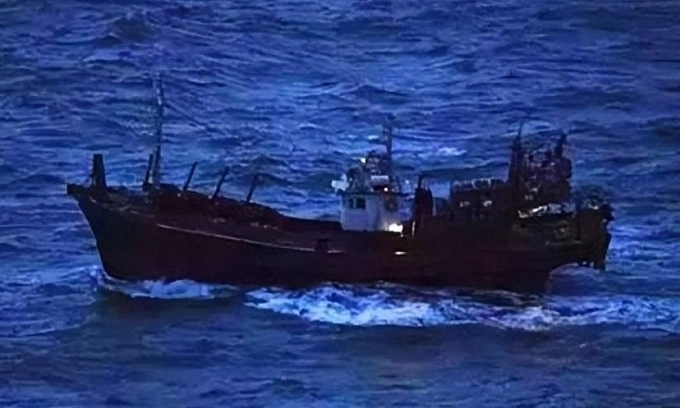


China Dissatisfied with the hard work and low pay, two rebels led a group of crew members to plan to hijack the ship, killing 16 people and leaving 6 missing.
On December 27, 2010, fishing boat Lu Rongyu 2682 of Ham Phat Aquatic Food Co., Ltd. carrying 33 crew members left the port in Shidao, Rongcheng City, Shandong Province.
The Vinh Ngu 2682 is a deep-sea squid fishing vessel, 30-40 m long, operating offshore since 2000. The destination of this voyage is the Southeast Pacific Ocean.
Captain Li Chengquan, 42, from Liaoning Province, temporarily recruited 32 crew members from many provinces, including failed businessmen, recent university graduates, migrant workers… Most of them had the idea of going on a trip to make quick money, not understanding that this job was not easy.
On July 25, 2011, Ham Phat Company received a distress signal from Lu Rong Yu 2682 and immediately requested assistance from the competent authorities. On July 29, Chinese Fishery Ship 118 arrived at the waters where Lu Rong Yu 2682 was in distress and towed the ship, whose cabin was flooded, back on August 12, 2011. After that, the 11 survivors on board were arrested, clarifying the mystery of the offshore tragedy.
From greed to 'dilemma'
According to the judgment of the Intermediate People's Court of Weihai City, from June 17 to July 25, 2011, while the Lu Rongyu 2682 was fishing in the waters near Chile, some crew members, dissatisfied with the long, high-intensity working hours and low wages, planned to hijack the ship and wanted to return to China to demand an explanation from the company. However, due to internal conflicts and other factors, the hijacking turned into a bloody war at sea.
According to the contract, the crew members must stay at sea for two years, their main job is to catch squid, then pack and freeze it.

Liu Guiduo, 27, from Heilongjiang Province, and Bao De, a native of Inner Mongolia, were the masterminds of the hijacking. The two conspired with Jiang Xiaolong, Liu Chengjian, Huang Jinba and others, deciding to carry out the robbery after the fishing boat refueled in Chilean waters on the evening of June 16, 2011.
Li Meijin, a professor of criminal psychology at the China Public Security University, explained that in cases involving multiple criminals, it is often necessary to distinguish between the mastermind and accomplices, as their psychology is different. “Some of the original members who joined Du and De’s group were motivated by personal interests, thinking that following them would help them make more money,” said Professor Li.
Ma Ai, a professor at the Institute of Social Sciences at China University of Political Science and Law and deputy director of the Center for Criminal Psychology Research, said the ringleaders took advantage of a common desire among some crew members to go home as soon as possible. Heavy workloads and low pay fueled a general sense of dissatisfaction with working conditions and benefits, as well as resentment toward the captain.
“They rationalized the hijacking plan by holding the captain responsible and arguing: We had no choice but to do it. They believed they had a legitimate reason and made the decision to commit the crime by denying responsibility and emphasizing the other party’s fault, so the participants in the plan did not feel guilty,” said Professor Ma.
At around 11pm on June 16, 2011, Doat ordered Ba and Vuong Bang to sabotage and disable the ship's communication and positioning systems. They rushed into the captain's room with knives and sticks, restrained him and threatened him to change course to China.
Chef Ha Ky Dung discovered the incident and fought back with a knife. Long stabbed him, knocked him to the floor, and threw him into the sea. Dung's death opened the way for a series of massacres to follow.
“If you don’t pull back in time when you first harm someone, they will have less chance to fight back. Since you have killed someone, the mastermind will take advantage of this to threaten you to obey whether you want to or not, and the accomplices will fall into a dilemma,” Professor Ly analyzed.
The battle for survival at sea
According to Professor Ma, this case was a deliberate criminal activity from the beginning, with clear psychological and behavioral preparation for the use of violence. Although the goal was to rob the train, their plan, tools, and assignment clearly included contingency plans for resistance.
After the first murder, the nature of the incident changed. “They knew that murder was a crime and feared legal punishment, and the need to escape the law now played a role in their actions. If the motive of the hijacking was profit, then the actions after the murder were all for the purpose of self-preservation,” said Professor Ma.
Faced with the situation of someone being killed and being threatened, the captain also had a change in mentality. The indictment stated that Ly Thua Quyen, Thoi Dung and Doan Chi Phuong, in order to save their lives, actively joined Doat's group.
More than a month after the first murder, Doat and his accomplices suspected that someone wanted to “rebel”. They discovered that the chief engineer, Wen Dou, had deliberately sabotaged the ship’s equipment, and that fuel consumption had suddenly increased several times per day. Therefore, they created a so-called “black list”, and one by one, they called six people who were suspected of having rebellious intentions out of the room and executed them. Three others who were not on the list were also murdered.
Even Doat and Duc, the two who had joined forces from the beginning, suspected each other. In the end, Doat killed all the crew members in Duc's group.
Professor Ma explained that after the massacre began, everyone on board was in a state of extreme tension and anxiety. This not only led to irrational thinking and decisions, but also caused people to be dominated by a defensive mentality, easily exaggerating danger, and giving rise to suspicion and fear of others. In a situation where everyone was insecure, vigilant, and fighting for life and death became the best way to protect themselves.
According to Professor Ma, this change in mentality is first of all related to the situation at that time. The offshore fishing boat is alone in the ocean, has limited space, and lacks external support, so adapting to the current environment becomes the only option. Second, many participants may think that since everyone is involved, no one will report the case. Third, the pressure of being threatened leads to herd behavior. Finally, it is related to group polarization.
In social psychology, group polarization is the phenomenon where, when discussing in a group, people tend to make decisions that are more extreme than their initial individual decisions, leaning towards one extreme of risk-taking or conservativeness and thus deviating from the optimal decision.
Whether to commit a crime or not depends on human 'character'
Although the isolated and closed environment of offshore fishing vessels amplifies the emotions of criminals to a certain extent, Professor Li believes that whether or not a crime is committed depends on the “character” of the person himself.
“Even in extreme circumstances, people still have the strength to persevere for justice,” said Professor Li. He believes that if among the accomplices there were one or two people with some sense of the law, a rational mind, and some leadership qualities, they could have used roundabout measures to resolve the crisis. As long as everyone worked together to control the leading rebel crew member, the situation would not have gotten out of control.
However, most of the crew members are new to the profession and young. Professor Ly believes that their thinking is quite simple and hasty, so when faced with such a situation, it will be difficult for them to control the situation.
“The leaders of the rebellion were not motivated solely by greed; their motive for committing the crime was clear, premeditated murder. These criminals were inherently ruthless, which is why they became the masterminds,” said Professor Li. According to him, once such a “leader” appeared in a criminal group, the others could only submit.

The turning point came when the engine room flooded, causing the ship to tilt in the early morning of July 25, 2011. Some crew members tried to escape in the chaos, but were forced by Doat's group to jump into the sea and went missing. Doat's group attempted to escape to Japan, pretending to be kidnapped to avoid investigation. However, the ship leaked, forcing them to turn on the communication equipment and positioning system to call for help.
On July 19, 2013, the Intermediate People's Court of Weihai City, Shandong Province issued a first-instance verdict against 11 defendants in the particularly serious murder and robbery case on the fishing vessel Lu Rongyu 2682.
The five main perpetrators, Liu Guiduo, Jiang Xiaolong, Liu Chengjian, Huang Jinba and Li Chengquan, were sentenced to death. Wang Peng received a suspended death sentence, and the remaining five defendants were sentenced to life imprisonment or fixed-term imprisonment.
On January 21, 2015, the Shandong Provincial High People's Court rejected the defendants' appeal and upheld the original verdict. The five defendants were executed on March 23, 2017.